Stop Expecting AI Companies to Behave Like EdTech Companies
The communication and graphical design company, Canva, proudly announced AI Voice Generator this past summer. Users can now let AI narrate their presentation. After reading the announcement, I literally threw my hands in the air. As an instructor, why on Earth would I want my students to have software that allows them to remove one of the core learning activities I am asking them to practice
The simple answer is staring us in the face: Canva isn’t an educational technology company. AI companies are not bad at education, rather they’re optimizing for a fundamentally different goal than educators are. The friction results from a misalignment between what instructors want and need and the AI companies that are building the next general-purpose computing.
For example, most people have stage fright and can’t stand hearing their own voice. So, the teams at Canva identified a real problem real people have: can someone please do this presentation for me? Can I find someone who won’t stammer and say “um” 500 times, and deliver a logical sequence of thoughts? If you’re working at Canva, looking for the next hit feature for your millions of business users, of course automatic narration looks like a valuable product.
EdTech generally has a low reputation amongst instructors. Learning Management Systems (LMS) can be clunky. EdTech software is nowhere near as polished as that of the big tech companies like Apple, Google, or Anthropic. High costs and vendor lock-in are also real problems. And so on.
But for the most part, instructors tend to use EdTech products because they are purpose built to solve or at least grease the wheels of real pedagogical or bureaucratic problems. LMSs help standardize student experiences and manage large amounts of data (assignments and grades). Poll Everywhere helps instructors get real time vibes or identify knowledge gaps from their students. Instructors turn to Perusall to help make reading more meaningful by making it social, thus increasing presence with their students.
EdTech companies exist because schools exist, much like how Lockheed Martin exists because the United States Airforce exists. While EdTech companies build products around educational goals, AI companies don’t. Higher Ed has been treating AI like the next generation of EdTech when it’s actually something fundamentally different.
EdTech often frustrates faculty because it tries—and sometimes fails—to serve educational goals. AI by contrast often frustrates faculty because serving educational goals isn’t its primary job. Consider the misalignment between faculty and students and what AI companies tend to optimize for:
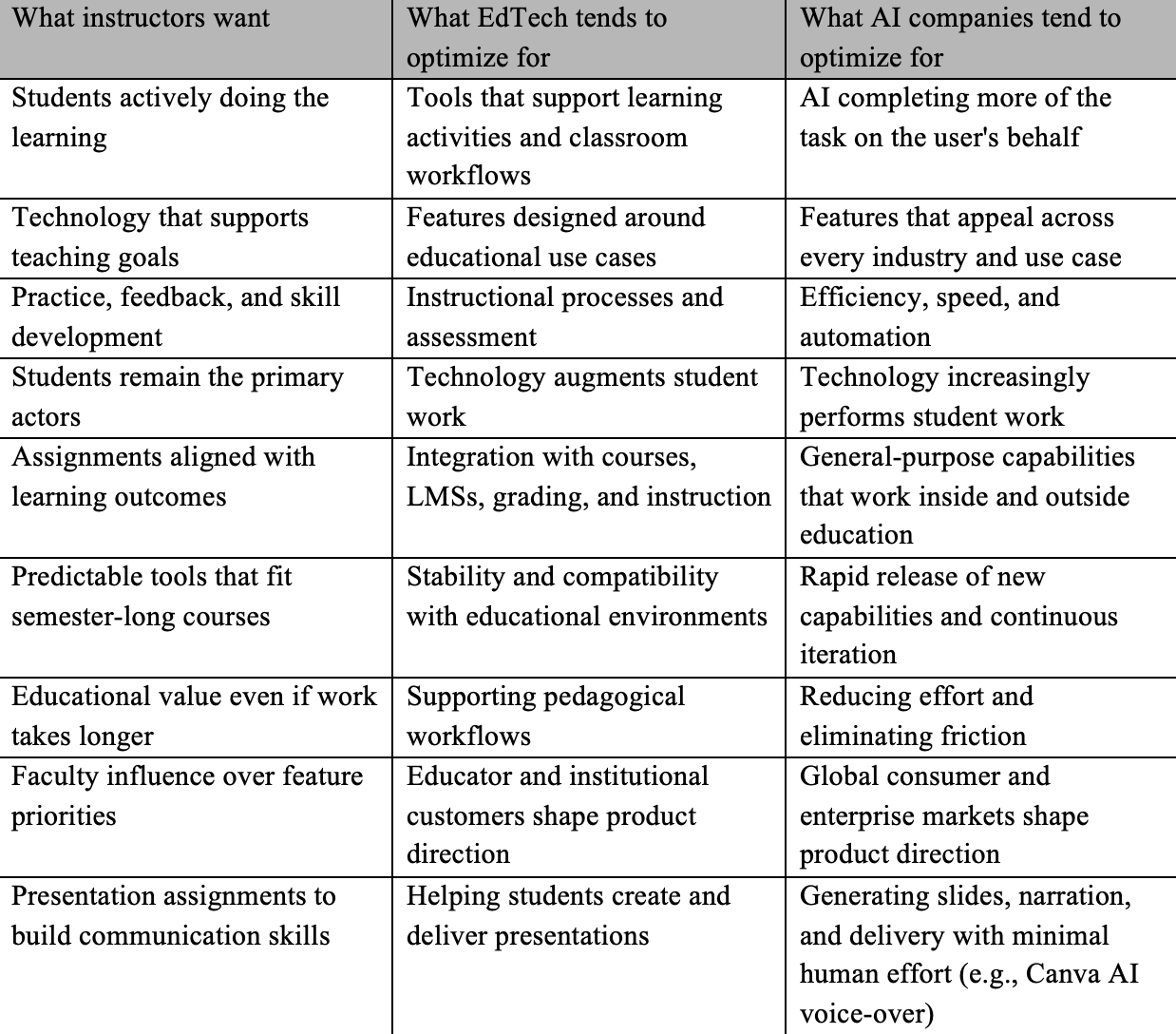
The misalignment between higher education and AI is not about good versus bad technology. Instructors, EdTech companies, and general-purpose AI companies are often optimizing for fundamentally different goals.
There is one important exception. AI companies and many students are often remarkably well aligned. Students are navigating environments characterized by heavy workloads, competing demands, and high-stakes evaluation. AI companies build products that reduce effort, save time, and complete tasks more efficiently. That alignment helps explain why generative AI spread through higher education so quickly, and why it became intertwined with concerns about academic integrity almost immediately.
Returning to Canva AI Voice Generator. If you’re an instructor helping your students tell sociological stories through visually appealing but data rich graphics, then AI Voice and Slide Generator are explicitly not what you want. The presentation is much more than a product, it is a learning process, one where students find and practice their voice, judgement, aesthetics, and sociology. Removing those activities removes the learning opportunity.
Whereas traditional EdTech could be adopted or done away with, AI isn’t something a university can simply choose not to have or ignore. Consider Microsoft, Google, Adobe, Canva, and Apple, not to mention OpenAI and Anthropic, the new AI-first companies. These are the platforms for everyday computing, not EdTech companies. Each platform is integrating AI whether instructors ask for it or not. Some of it is useful, some of it is not. Nonetheless, they are building these tools for everyone, not just higher education.
Everyone in higher ed, including students, uses hardware and software from most of these companies to organize and conduct their digital lives, which is increasingly infused with some form of AI. That could be machine learning for your digital photography, quick answers provided by Google Assistant or the new Siri Ai, or a large language model from Anthropic or OpenAI. We are well past adoption and deep into integration. And no one is feeling the pain as much as faculty and many students because the friction lies in a fundamental misalignment.
Instructors succeed when students grow and learn. Students succeed when they are exposed to new ideas, practice new skills, and earn their degree. EdTech succeeds when higher education succeeds. AI companies, by contrast, succeed when AI becomes useful everywhere—including places where higher education would actually prefer people continue doing the work themselves.
I’m not arguing that we should be nostalgic for the era of traditional EdTech. Faculty have plenty of legitimate complaints about Learning Management Systems, textbook platforms, and proctoring software. But those tools were at least designed with education in mind. That doesn’t mean they always served education well. It does mean that supporting teaching and learning was part of the design problem they were trying to solve.
Instructors aren’t imagining the friction with AI. They are feeling it when one institution optimized for learning is embedded in a digital world that increasingly relies on companies optimized for something entirely different. Students are often caught in the middle of this misalignment. General-purpose technology companies—including today’s AI companies—are solving a different problem. Their products must work for marketers, lawyers, software engineers, accountants, students, and everyone else. Education is one use case among many, not the organizing principle.
The challenge for higher education isn’t to pretend AI companies are EdTech companies, nor to reject them because they aren’t. It’s to recognize the misalignment for what it is. We should expect to articulate higher ed’s goals, advocate for them, and work with technology companies to build the products, guardrails, and educational experiences that better align powerful AI systems with learning. Other times, it means acknowledging that the fit feels bad because sometimes it is simply a bad fit.